

How to Care for R.M.Williams Boots (Proper Cleaning, Conditioning, and Maintenance)
You’ve paid good money for your R.M.Williams boots. They’re made to last, but they won’t do it on reputation alone. Leather wears every time you walk, flex, sweat, dry, and repeat. What determines whether your boots age well or fall apart early isn’t one miracle product or an annual overhaul. It’s the small, boring things done consistently.
This guide explains how to look after smooth leather RM Williams boots, what actually matters, how often to do it, and where most people come unstuck.
Once you understand leather, care makes sense
R.M.Williams boots, whether yearling or kangaroo, are made from tightly packed collagen fibres. Those fibres need two things to behave properly: moisture and natural fats.
When moisture drops, leather stiffens. When fats are lost, elasticity drops. The leather still bends, but it doesn't recover. Push either too far and you end up with deep creasing, stretching, or collapse. Add too much back and the structure weakens just as quickly. Good care is about balance, not saturation.
Caring for R.M.Williams boots
From the first wear, flex lines appear across the vamp. That's normal. What matters is what happens after you take the boots off.
If leather isn't supported and allowed to recover between wears, those flex points start to harden. Creases deepen, recovery slows, and what began as cosmetic wear turns structural. R.M.Williams leathers are durable and forgiving, but they still need help while resting. Care isn't optional - it's the difference between boots that age beautifully and boots that fall apart.



The R.M.Williams care routine
The following steps outline a simple care routine for RM Williams boots. If worn regularly, most people should revisit the full routine every four to six weeks.


Step 1. Care after every wear
Two things matter more than everything else combined.
Brush your boots.
Dust and grit left on the surface act like sandpaper every time the leather flexes. A quick brush removes what would otherwise grind away at the finish.
Use boot trees.
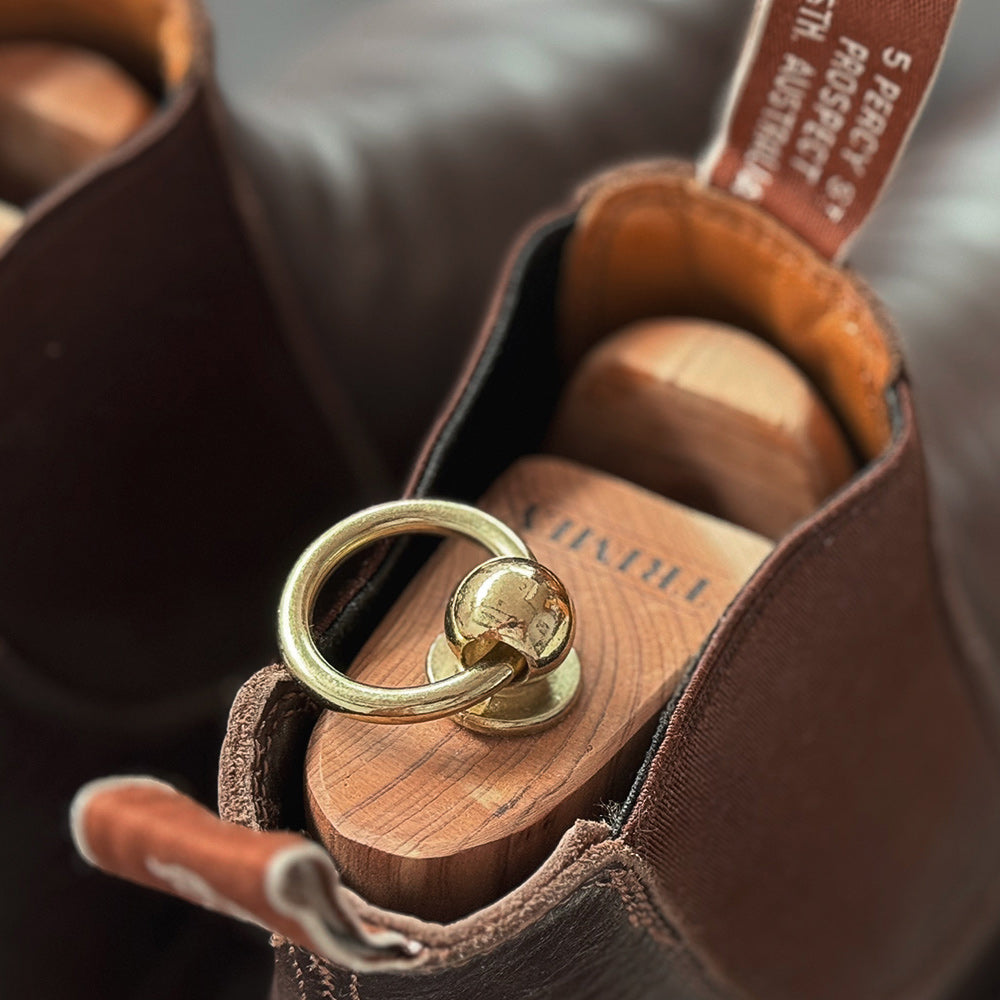
Yearling and kangaroo leather crease more readily than thicker cowhide. Boot trees absorb internal moisture and support the vamp while the leather settles. This is where shape is either preserved or lost. Trimly designs its boot trees specifically around the proportions of R.M.Williams boots to support this high-stress area properly.


Step 2. Clean the leather
Clean when boots look flat, feel dry, show visible buildup, or have been worn in wet or dusty conditions.
Start with a thorough brush.
- Light surface dirt can be removed with a slightly damp cloth.
- For everyday grime or product buildup, use a mild leather cleaner applied with a cloth, then wipe away residue.
- For heavy buildup, cracked polish, or ingrained dirt, use a residue-removing cleaner made for footwear. Use sparingly. Saddle soap should only ever be a last resort.
Let the boots dry naturally and condition soon after.


Step 3. Condition for longevity
Conditioning replaces what leather loses through wear and exposure. Dab a small amount on an application cloth and apply evenly across the leather’s surface. For older boots, focus a bit more on the flex points. Let it absorb for ten or so minutes, then brush off any excess. Always remember “less is more”. Over-conditioning is far more common than under-conditioning.


Step 4. Refresh the colour and finish
Shoe cream restores colour and evens out scuffs without the heavy buildup of wax. Thinner creams absorb more readily and nourish the leather. Thicker creams sit closer to the surface and help where colour has faded.
A good shoe cream can be your main polish. Use it sparingly and stop before the leather looks saturated.


Step 5. Polish for protection and shine
Cream polish adds a soft sheen. Wax polish adds shine. If you use wax, keep it to the toe and heel only. Across flex points it cracks, flakes, and looks tired quickly. Wax polish is a finish layer, not a substitute for cleaning or conditioning.


Step 6. Store and rotate
Avoid wearing the same pair day after day. Leather needs time to recover. Rotate pairs where possible and store boots with trees inserted. For long-term storage or travel, breathable cotton boot bags protect the surface without trapping moisture.


Wet leather boots? Easy fix.
If boots get wet, wipe off surface moisture and loosely stuff them with newspaper. Leave them in a warm, ventilated space, well away from direct heat. Once partly dry, remove the paper and insert boot trees so the leather finishes drying in shape. When fully dry, apply a light conditioner if the leather feels tight or looks dull. Heat dries leather too fast and too unevenly. That’s how cracking starts.


Seasonal Considerations
Cold and wet conditions call for more frequent brushing and drying. Check leather every four to six weeks. In hot or dry climates, leather loses moisture faster, so condition proactively and keep boots away from heat and sun. In humid conditions, airflow matters. Store boots somewhere breathable to avoid mould.
Where boot care usually goes wrong
A proper shoe care routine will extend the life of your RM Williams boots, but incorrect care can do more harm than good:
- Moisture left inside the boot accelerates degradation of the lining and leather over time.
- Dust and fine grit left on the surface act as abrasives, especially across flex points.
- Using heat to dry boots causes leather to dry too quickly and unevenly, damaging the collagen structure that gives leather its strength and elasticity.
- Over-conditioning softens leather excessively and reduces structural recovery.
- Over-polishing with wax leads to cracking, dullness, and poor wear over time.
Most issues blamed on leather quality are actually caused by poor moisture management and lack of support during rest.
When to see a cobbler
A professional cobbler can help with sole replacement, heel repair, and structural issues. But they can't fix everything. Leather that's been allowed to dry out completely, or that's been saturated with the wrong products, may be beyond repair. The best cobblers are preventative—they help you catch issues early before they become structural problems.
A simple rule worth remembering
If your boots feel dry, they probably are. If they look flat, they probably need conditioning. If they smell musty, they need air. Listen to what your boots are telling you, and they'll tell you what they need.
Questions R.M. Williams owners often ask
-
Often posted with photos of deep vamp creases on relatively new boots. A few things are usually going on, sometimes more than one:
- Flex points are unavoidable. Chelsea boots crease across the vamp. That’s where the leather bends every step.
- You don’t know the leather’s starting point. Boots can sit in boxes for months. The leather may already be dry when you buy them. A light condition early on helps the leather flex more evenly.
- Shoe trees come too late. Many buyers new to the welted shoe rabbit-hole learn about shoe trees after creases have already set. Once they’re in, they don’t magically disappear.
- Not all leather creases the same. Thinner leathers like yearling and kangaroo will show creases more readily than thicker cow leather. How the hide was cut also matters. Leather taken closer to the belly is looser and will crease more easily than leather cut closer to the spine, which is typically tighter and more resistant to deep creasing.
Remember, creasing is a normal part of owning leather boots. It’s a sign they’ve been worn and racked up some miles, not a flaw. Managed well, it’s simply part of the character your boots develop over time - the boots pictured herein are 15-years+
-
Most of the time, it’s just creasing. Creases form where the leather bends, especially across the vamp, and they’re normal on Chelsea boots. They tend to soften when the boots rest on shoe trees. Cracking is different. Cracks cut across the grain, stay visible when the boots are off, and often look lighter in colour. In many cases, what looks like cracking is actually wax polish breaking up on the surface. Strip the wax and the leather underneath is often fine. Actual leather cracking usually only appears after the leather has been neglected or allowed to dry out for a long time.
-
Often, nothing. Yearling leather doesn’t show conditioning in an obvious way. It stays fairly matte even when it’s healthy. If you keep adding conditioner trying to chase a shine, you’re more likely to overdo it. Another common issue is surface buildup from old cream or wax, which can make the leather look flat even when it isn’t dry. In most cases, the fix isn’t more conditioner, it’s less product and better cleaning.
-
…and the Darwin Award for best shoe care attempt goes to…
Most DIY shoe care disasters fall into one of three categories.
Easy to fix
Usually the result of enthusiastic cream or wax layering. In most cases, the leather underneath is fine. The fix is simple: strip the buildup properly and start again with a lighter hand.Fixable with professional help
This is where things get more adventurous. Think industrial-strength cleaners or “something I found under the sink” that’s stripped pigment from the leather. At this point, I'd hand it over to the professionals who may need to reconditioning and, in some cases, recast the dye.Usually permanent
This is where creativity meets consequences. Common examples include using a darker shoe cream on lighter leather, blasting the boots with a heat gun to dry them “quickly”, or chronically saturating the leather with care products. Once the leather’s colour or structure has been altered at this level, there’s no true way back. -
Usually not. Fresh water or sweat marks can often be evened out with proper cleaning and light conditioning. Alternatively, you could re-soak (not overly so) the leather with a water spray bottle set to fine mist.
Problems start when boots are dried unevenly or with heat, which can make them more stubborn to remove. If the marks don’t change at all after gentle care, stop experimenting and consider professional help.
-
Some movement is normal for sure, but loss of shape doesn't need to be inevitable. Leather relaxes with wear, especially across the vamp on Chelsea boots, but it should still recover when the boots rest. When shape loss becomes noticeable, it’s usually down to poor recovery between wears: no boot trees, repeated wear without rest, or moisture left inside the boot. With proper drying time and consistent use of boot trees, R.M.Williams boots should hold their shape for years rather than gradually collapsing.